


Page 37 - 2020 Auto Show Guide
P. 37
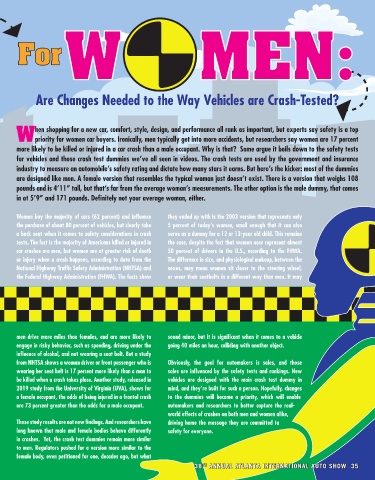
Designing            W    MEN:


 Safety  For


             Are Changes Needed to the Way Vehicles are Crash-Tested?


            hen shopping for a new car, comfort, style, design, and performance all rank as important, but experts say safety is a top
      Wpriority for women car buyers. Ironically, men typically get into more accidents, but researchers say women are 17 percent
      more likely to be killed or injured in a car crash than a male occupant. Why is that?  Some argue it boils down to the safety tests
      for vehicles and those crash test dummies we’ve all seen in videos. The crash tests are used by the government and insurance
      industry to measure an automobile’s safety rating and dictate how many stars it earns. But here’s the kicker: most of the dummies
      are designed like men. A female version that resembles the typical woman just doesn’t exist. There is a version that weighs 108
      pounds and is 4’11” tall, but that’s far from the average woman’s measurements. The other option is the male dummy, that comes
      in at 5’9” and 171 pounds. Definitely not your average woman, either.


      Women buy the majority of cars (62 percent) and influence   they ended up with is the 2003 version that represents only
      the purchase of about 80 percent of vehicles, but clearly take   5 percent of today’s women, small enough that it can also
      a back seat when it comes to safety considerations in crash   serve as a dummy for a 12 or 13-year old child. This remains
      tests. The fact is the majority of Americans killed or injured in   the case, despite the fact that women now represent almost
      car crashes are men, but women are at greater risk of death   50 percent of drivers in the U.S., according to the FHWA.
      or injury when a crash happens, according to data from the   The difference in size, and physiological makeup, between the
      National Highway Traffic Safety Administration (NHTSA) and   sexes, may mean women sit closer to the steering wheel,
      the Federal Highway Administration (FHWA). The facts show   or wear their seatbelts in a different way than men. It may


      men drive more miles than females, and are more likely to   sound minor, but it is significant when it comes to a vehicle
      engage in risky behavior, such as speeding, driving under the   going 40 miles an hour, colliding with another object.
      influence of alcohol, and not wearing a seat belt. But a study
      from NHTSA shows a woman driver or front passenger who is   Obviously, the goal for automakers is sales, and those
      wearing her seat belt is 17 percent more likely than a man to   sales are influenced by the safety tests and rankings. New
      be killed when a crash takes place. Another study, released in   vehicles are designed with the main crash test dummy in
      2019 study from the University of Virginia (UVA), shows for   mind, and they’re built for such a person. Hopefully, changes
      a female occupant, the odds of being injured in a frontal crash   to the dummies will become a priority, which will enable
      are 73 percent greater than the odds for a male occupant.   automakers and researchers to better capture the real-
                                                        world effects of crashes on both men and women alike,
 WOMEN BUY  These study results are not new findings. And researchers have   driving home the message they are committed to

 THE MAJORITY 62%  long known that male and female bodies behave differently   safety for everyone.
      in crashes.  Yet, the crash test dummies remain more similar
 OF CARS  to men. Regulators pushed for a version more similar to the
      female body, even petitioned for one, decades ago, but what
                                                                 38  ANNUAL ATLANTA INTERNATIONAL AUTO SHOW  35
                                                                   TH

